Agentic AI Engineering: 100 Labs to Production-Ready System
From Vibe Coding to Sovereign HQ: Architect and Deploy 100 Production Labs using MCP, AP2, and TEE Security.
 Updated on Sep, 2026
 Language - English
AI Assistant

Lectures -112
Resources -100
Duration -1 hours
Lifetime Access

Lifetime Access
30-days Money-Back Guarantee
Get your team access to 10000+ top Tutorials Point courses anytime, anywhere.
Course Description
The Agentic Engineering Revolution: Beyond "Vibe Coding:In early 2025, the industry was captivated by "Vibe Coding"—a methodology of intuitive, natural-language-driven development. While liberating for rapid prototyping, vibe coding often leads to a "Sugar Rush" of productivity that quickly collapses into technical debt and unmaintainable code.By 2026, the industry has shifted. Agentic Engineering is the evolution of software development. It moves beyond syntax to Spec-Driven Development (SDD), where human engineers define rigorous architectural contracts and autonomous agents implement, test, and verify them. This course is designed to turn you into an Agentic Engineer: the professional who ensures AI-co-created code is production-ready, secure, and resilient.
The 100-Lab Journey to Mastery: This comprehensive, 10-module journey takes you through 100 hands-on labs, moving from deterministic logic to the governance of a Sovereign Digital Headquarters.
- Modules 1-2: Solving the Stochasticity Barrier Build logic funnels to force LLM outputs into strict JSON schemas. Architect hierarchical memory systems that mimic human RAM and archival retrieval. By Lab 10, you will deploy an autonomous agent capable of maintaining state over a complex reasoning cycle.
- Modules 3-4: The Infrastructure of Interoperability Master the Model Context Protocol (MCP)—the "USB-C for AI." Dive into the architecture of specialized swarms (Researchers, Synthesizers, and Reviewers) managed via protocols that solve the N×M integration problem.
- Modules 5-6: Frontiers of Security and Commerce As agents handle sensitive data, we move into hardware-enforced Trusted Execution Environments (TEEs) using NVIDIA Blackwell and Intel SGX. Implement the Agent Payments Protocol (AP2) for secure, cryptographically signed financial mandates.
- Modules 7-9: Operationalizing Autonomy Build AgentOps pipelines for observability and self-healing systems. Explore the "Reliability Economics" of 2026, learning how to generate measurable business value through autonomous resilience.
- The Climax: Lab 100 – The Sovereign Digital Headquarters The "PhD Master Capstone." Architect a 12-hour "Micro-Trip" simulation where an entire autonomous workforce operates in a secure VPC native architecture. This is the ultimate proof of your ability to command an autonomous enterprise.
Who this course is for:
- The curriculum is segmented into three distinct professional personas representing the highest-demand roles in the 2026 talent market.
- The Aspiring Agentic Engineer: Software developers and senior engineers who realize that hand-writing code is becoming a bottleneck and wish to transition into "Intent Orchestration" and system-level management of AI workforces.
- he Business Automator: Operations leaders, fintech architects, and CTOs who need to deploy autonomous systems for procurement, contract management, or logistics that are auditable, secure, and compliant with global regulations like GDPR and the EU AI Act.
- The Senior Dev seeking Sovereignty: Privacy-focused engineers and security researchers who require deep mastery of air-gapped systems, hardware-rooted trust, and local LLM deployment to maintain absolute data sovereignty for government or regulated industry clients.
Goals
- Build Fail-Safe LLM Logic: Force non-deterministic outputs into strict JSON-RPC 2.0 schemas for zero-failure production.
- Engineer Cognitive Memory: Implement hierarchical session, vector, and archival stores to eliminate LLM amnesia and ensure long-term context retention.
- Scale Agent Connectivity: Utilize MCP to provide agents with standardized, plug-and-play access to heterogeneous data and APIs.
- Scale Agent Swarms: Implement specialized Supervisor and Network patterns to solve multi-domain problems through autonomous, coordinated agent swarms.
- Hardware-Enforced Security: Secure AI agents using TEEs (Intel SGX/NVIDIA Blackwell) to eliminate data-in-use vulnerabilities and privileged-access threats.
- Architect Agentic Payments: Use AP2 to facilitate auditable commerce through cryptographically signed intent and payment mandates.
- Master AgentOps Monitoring: Deploy causal trajectory visualization and distributed tracing to observe and debug complex, non-deterministic agent reasoning.
- Automate Self-Healing Ops Build autonomous MLOps pipelines that detect, diagnose, and repair their own execution errors, data drift, and CI/CD regressions.
- Engineer A2A Federation: Build global reputation ledgers and negotiation lifecycles for decentralized, cross-border agentic swarms.
- Architect Sovereign HQs: Implement territorially-bound digital infrastructure with 100% data residency and EU AI Act/DORA compliance.
Prerequisites
- The barrier to entry is maintained at a professional developer level to ensure that participants can handle the "Production-Grade" truth of the labs.
- Programming Mastery: Proficiency in Python 3.12+ is required, specifically focusing on asynchronous programming (asyncio), Pydantic for schema validation, and Type Hinting.
- Infrastructure Access: A local machine capable of running Docker and simulating Intel SGX environments. For production labs, access to cloud TEE instances (Azure DCsv3 or GCP Confidential VMs) is recommended.
- Tooling: Familiarity with modern IDEs like VS Code, Cursor, or Windsurf for agentic orchestration, and a basic understanding of Git-based CI/CD workflows.
- AI Foundations: A baseline understanding of Large Language Models (LLMs), tokenization, and temperature tuning is assumed.
Curriculum
Check out the detailed breakdown of what’s inside the course
Introduction
1 Lectures
-
 Introduction
06:18
06:18
Introduction
06:18
06:18
Module 1: foundations of agentic logic & determinism
11 Lectures

Module 2: cognitive memory architectures & shared state
11 Lectures
Module 3: the model context protocol (MCP) - "USB-C for AI"
11 Lectures
Module 4: multi-agent orchestration & design patterns
11 Lectures
Module 5: confidential computing & hardware-rooted security
11 Lectures
Module 6: agentic commerce & the AP2 protocol
11 Lectures
Module 7: agentOps, observability & evaluation
11 Lectures
Module 8: autonomous self-healing & agentic MLOps
11 Lectures
Module 9: agent2agent (A2A) & federated swarms
11 Lectures
Module 10: sovereign autonomous workforces
11 Lectures
Conclusion
1 Lectures
Instructor Details

Bayt Al Hikmah
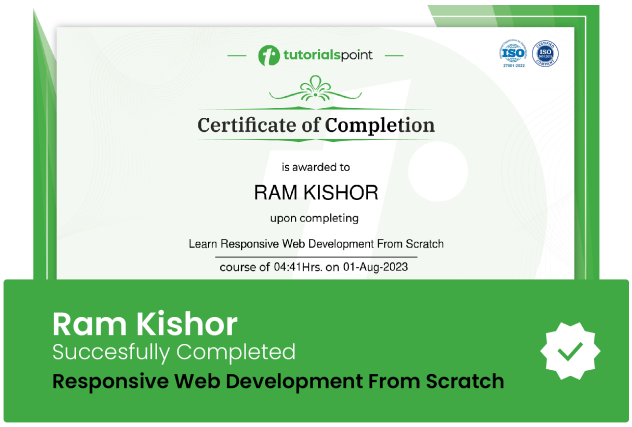
Course Certificate
Use your certificate to make a career change or to advance in your current career.
Our students work
with the Best















Related Video Courses
View MoreAnnual Membership
Become a valued member of Tutorials Point and enjoy unlimited access to our vast library of top-rated Video Courses
Subscribe now
Online Certifications
Master prominent technologies at full length and become a valued certified professional.
Explore Now