Customizing and Deploying Embedded Linux Systems
From Microcontroller Dependency to Principal Architect: Master Yocto, Secure Boot, RAUC OTA, eBPF, and Edge K3s
 Updated on Oct, 2026
 Language - English
AI Assistant

Lectures -112
Resources -100
Duration -1 hours
Lifetime Access

Lifetime Access
30-days Money-Back Guarantee
Get your team access to 10000+ top Tutorials Point courses anytime, anywhere.
Course Description
We only charge a fee solely for the time invested in building this comprehensive curriculum.
The Extinction of the Isolated Device
The embedded systems engineering landscape has shifted. The era of the isolated, low-power microcontroller running a basic super-loop or standalone RTOS is giving way to highly connected, intelligent, and sovereign edge nodes. Today, embedded architectures run electric vehicle drivetrains, coordinate autonomous drone swarms, control low-earth orbit satellite grids, and manage mission-critical industrial robotics.
With this massive scale comes immense structural risk. A single unhandled memory leak or security vulnerability in a fleet of one million deployed edge devices is no longer a simple software bug—it is an existential financial catastrophe. Because of this, the modern industry is desperately looking for Principal Embedded Linux Architects capable of designing "Zero-Failure" operating systems.
The industry is saturated with courses that teach you how to write application logic or rely on generative AI assistants to guess basic terminal commands. But when custom silicon arrives, when a security audit demands immediate compliance verification, or when a corrupt firmware update threatens to brick a nationwide fleet, graphical console abstractions and code-generators will not save you. You must know exactly how the operating system interacts with the underlying hardware layout.
The 100-Lab Production Forge
This training is an intense, practical engineering program containing 100 consecutive, hands-on labs. There are no surface-level summaries or superficial explanations. You will treat the Yocto Project, Buildroot, the Linux kernel, and cryptographic toolchains as raw materials to craft mathematically provable, secure operating platforms.
Every single lab is systematically validated through our uncompromising "Zero-Failure" Lab Design Framework:
- The Elevation: A clear, system-level analogy that strips away the conceptual abstraction of the tool before any code is executed.
- Safety & Strategy: You will explicitly learn to configure pre-flight verification checks, capture baseline environment states, and build structural "Panic Button" rollbacks before altering root filesystems or kernel variables.
- Extreme Implementation: You will execute precise build steps, write custom recipes, and build low-level configuration trees while learning exactly how the compiler, linker, and operating system kernels interact with the host and target architectures.
- Visual Verification: You will run real-time hardware-in-the-loop emulation via QEMU, analyze raw boot diagnostic dumps, and audit image footprints using strict production metrics.
- Master Class Troubleshooting: You will deliberately break your configuration to resolve three distinct, real-world field errors or compilation failures per lab.
The Climax: The 12-Hour PhD Capstone Project
The definitive proof of your systems engineering expertise is Lab 100: The Sovereign Autonomous Node Deployment.
In this challenge, you stop following step-by-step instructions. Acting as a Principal Architect for a sovereign defense contractor, you are given a raw ARM64 hardware specification for an industrial autonomous drone controller. You have exactly 12 hours. From an empty repository, you must build a custom Yocto Linux image containing a PREEMPT_RT kernel to ensure sub-millisecond motor latencies. The image must feature end-to-end Secure Boot validated by an emulated TPM 2.0 chip, a strictly read-only rootfs layout, and an automated A/B partition updates manager using RAUC over a simulated connection.
To pass, you will intentionally inject a catastrophic kernel panic payload into the update stream and cryptographically prove to auditors that your hardware watchdog and custom bootloader automatically catch the failure, drop out of the corrupted boot cycle, and initiate a clean, atomic rollback to the previous operational state—all while running an edge machine learning container via local K3s APIs without any external cloud access.
Take Ownership of the Silicon Stack
If you want to spend your career writing basic application code on pre-packaged operating systems, this course is not for you. But if you want to claim absolute technical sovereignty over the hardware-to-software boundary, design self-healing vehicle and aerospace configurations, and command premium mid-six-figure salaries—enroll now. Let's begin the initial build.
Who this course is for:
- Anyone Eager To Learn And Apply!
Goals
- Architect custom, production-grade embedded operating systems from the ground up using both the Buildroot philosophy.
- Compile and modify cross-compilation toolchains with fine-tuned parameters for custom ARM64 and x86-64 silicon environments.
- Enforce hardware-rooted security parameters, including cryptographic Secure Boot signing keys, TPM 2.0 TSS interfacing, and ARM TrustZone/OP-TEE deployments.
- Configure sub-millisecond latency deterministic control systems by patching, configuring, and building a custom PREEMPT_RT Real-Time kernel.
- Implement atomic, zero-risk fleet Over-The-Air (OTA) update frameworks with dual A/B partition layouts, hardware watchdogs, and signed RAUC or Mender bundles.
- Deploy resource-optimized, containerized Edge AI models and lightweight Kubernetes (K3s) orchestration clusters directly onto low-power custom boards.
- Profile kernel-level I/O anomalies and network latencies with zero overhead using custom eBPF probes, perf, and systemd-analyze traces.
- Automate regulatory compliance frameworks by integrating automated CycloneDX software bills of materials (SBOM) to meet strict EU Cyber Resilience Act mandates.
- Survive a 12-hour air-gapped disaster recovery simulation, building a self-healing, read-only AI drone operating system from an empty repository.
Prerequisites
- Operating System: A dedicated development machine running Ubuntu 22.04 or 24.04 LTS (native installation highly recommended, or a performance-allocated WSL2 environment on Windows 11).
- Hardware Specifications: Multi-core x86-64 CPU (minimum 8 physical cores recommended for Yocto compilation acceleration), 16GB RAM minimum (32GB preferred), and at least 150GB to 250GB of free high-speed SSD storage. No physical target hardware boards are required—all embedded environments are fully emulated via QEMU.
- Software Stack: Docker Engine and Git must be installed on your build host prior to beginning Module 1.
- Prior Knowledge: Intermediate familiarity with C/C++ programming and regular command-line operations (navigating directories, scripting fundamentals). No prior kernel-level development, board support package (BSP) writing, or systems-architecture experience required; the course scales linearly from basic execution to enterprise-grade mastery.

Curriculum
Check out the detailed breakdown of what’s inside the course
Videos
12 Lectures
-
 Introduction
05:56
05:56
Introduction
05:56
05:56
-
Module 1: Foundations, Local Environment Setup & Initial Success
06:55
06:55
-
Module 2: Buildroot Mastery & Root Filesystem Engineering
05:59
05:59
-
Module 3: Yocto Project Deep Dive - BitBake & Layers
05:09
05:09
-
Module 4: Advanced Hardware Support - Bootloaders & Custom Kernels
06:41
06:41
-
Module 5: Userspace Provisioning & Advanced IPC
06:53
06:53
-
Module 6: Hardware-Rooted Security & Zero-Trust Architecture
06:40
06:40
-
Module 7: Edge Connectivity & Protocol Orchestration
07:41
07:41
-
Module 8: Fleet Orchestration & Over-The-Air (OTA) Updates
05:42
05:42
-
Module 9: Production Diagnostics, CI/CD & eBPF
07:21
07:21
-
Module 10: Sovereign Deployment & Autonomous Edge
07:48
07:48
-
Conclusion
04:58
04:58
Labs
100 Lectures

Instructor Details

Bayt Al Hikmah
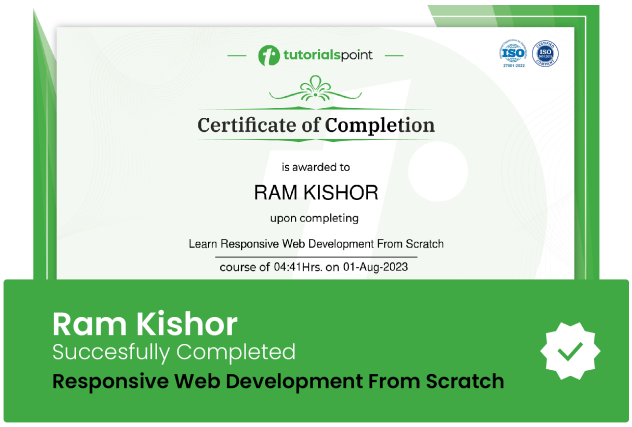
Course Certificate
Use your certificate to make a career change or to advance in your current career.
Our students work
with the Best
















Related Video Courses
View MoreAnnual Membership
Become a valued member of Tutorials Point and enjoy unlimited access to our vast library of top-rated Video Courses
Subscribe now
Online Certifications
Master prominent technologies at full length and become a valued certified professional.
Explore Now