High-Performance 3D Graphics Programming : Modern OpenGL
From Local Rendering to Cloud-Native GPU Systems: Master Compute Shaders, PBR, mTLS, and Headless Kubernetes.
 Updated on Sep, 2026
 Language - English
AI Assistant
English [CC]

Lectures -112
Resources -100
Duration -1 hours
Lifetime Access

Lifetime Access
30-days Money-Back Guarantee
Get your team access to 10000+ top Tutorials Point courses anytime, anywhere.
Course Description
We only charge a fee solely for the time invested in building this comprehensive curriculum.
The Extinction of the Local Draw Call
The high-performance graphics domain has undergone a massive paradigm shift. Traditional engineering tracks that prioritize isolated game development loops or basic local loop architectures are fundamentally misaligned with modern enterprise realities. In 2026, the demand for 3D rendering has transformed into a core infrastructure requirement. We are operating in the era of automated digital twins, planetary-scale simulation engines, and spatial cloud clusters powered by NVIDIA Blackwell architectures.
The responsibilities of a contemporary Staff Graphics Engineer have expanded far beyond simply writing basic fragment code or loading asset files. Today’s industrial standard demands a hybrid specialist: a GPU data engineer and software architect capable of piping secure geometry over zero-trust, air-gapped sovereign clouds while adhering to strict GDPR, DORA, and EU AI Act compliance gates. Traditional workflows that rely on local windows and manual interfaces are obsolete during an emergency. The modern industry demands autonomous orchestration pipelines that can ingest encrypted data and stream compressed framebuffers under high-concurrency constraints.
The 100-Lab Production Gauntlet
This course represents an uncompromising, production-grade gauntlet of 100 sequential, hands-on engineering labs. It is intentionally designed to strip away high-level abstractions, forcing you to interface directly with the graphics state machine and the underlying hardware pipeline.
Every single lab is constructed around a strict, production-validated "Zero-Failure" Design Framework:
- The Elevation: An unvarnished system-level analogy mapping the logical step from previous execution pipelines into current architectures.
- Safety & Strategy: Before execution, you will explicitly setup pre-flight verification checks, initialize boundary-monitoring safety loops, and create precise fallback handles to protect your runtime environment.
- Extreme Implementation: You will commit native code blocks to configure the driver state while tracing how the underlying OS, memory buses, and GPU shader cores handle the data allocation patterns behind the scenes.
- Visual Verification: You will run raw console logging, dump framebuffer arrays, and match matrix transformations directly against deterministic target benchmarks.
- Master Class Troubleshooting: You will break your code to manually diagnose and eliminate three distinct, real-world architectural bugs or driver faults per lab.
The Climax: The 12-Hour Sovereign Capstone
The ultimate proof of your engineering transformation is Lab 100: Sovereign, Cloud-Native PBR Engine with Autonomous Orchestration.
You will be given an empty canvas, a local Kubernetes node, and a 12-hour countdown window. You are tasked with assembling a headless OpenGL microservice utilizing EGL contexts packaged within an enterprise Docker chassis. Your engine must accept incoming, encrypted asset packages via an mTLS-validated endpoint, unpack the geometry securely in memory, leverage compute shaders to run high-speed frustum culling and parallel data modifications, execute a full photorealistic PBR/IBL pass with real-time omnidirectional shadows, and compress the rendering target.
The delivery model is a low-latency, secure framebuffer streaming vector to a remote node, coupled with a production-ready telemetry framework logging raw VRAM limits, shader compilation latencies, and execution metrics. If a node fails, your orchestration layer must intercept the error string and hot-swap the microservice without taking down the cluster.
Transition Into Architectural Authority
If your goal is simply to build toy models, use artistic UI generation packages, or guess parameters using consumer wrappers, this training is not for you. But if you are ready to claim structural mastery over the GPU pipeline, write hyper-secure distributed rendering setups, and secure a spot at the pinnacle of infrastructure development—enroll now. Let’s configure the engine.
Who this course is for:
- Anyone Eager To Learn And Apply!
Goals
- Architect production-grade graphics contexts and secure, hardware-rooted windowing pipelines using GLFW and GLAD.
- Orchestrate low-level VRAM allocation vectors by designing zero-failure state tracking models with VAOs, VBOs, and EBOs.
- Optimize spatial manipulation logic through high-performance vector algebra, perspective projections, and SIMD-aligned transformation matrices.
- Compile modular, enterprise-encapsulated GLSL shader builds featuring strict preprocessor directives and linear color-space gamma gates.
- Engineers photorealistic simulation environments by deriving the full Cook-Torrance PBR rendering equation and Image-Based Lighting (IBL).
- Manipulate complex geometry structures using Shader Storage Buffer Objects (SSBOs) and parallel compute shader reduction loops.
- Execute headless, off-screen hardware rendering pipelines leveraging EGL within secure, containerized architectures.
- Isolate proprietary CAD and mesh telemetry through mTLS-secured Kubernetes distribution trees running over live GPU passthroughs.
- Survive a comprehensive 12-hour disaster recovery evaluation by assembling a fault-tolerant, auto-scaling rendering microservice entirely from scratch.
Prerequisites
- Operating System: Access to a modern Linux workstation (Ubuntu 22.04/24.04 LTS or similar with native NVIDIA drivers), macOS, or a Windows 11 host configured with WSL2.
- Hardware Profile: A dedicated GPU supporting at least OpenGL 4.3 core profile (NVIDIA Pascal or newer, AMD GCN 2nd Gen or newer). Intel integrated graphics are discouraged for the advanced compute shader modules.
- Software Stack: A local C++ compiler toolchain (GCC 12+, Clang 15+, or MSVC 2022) supporting C++20 or newer. Docker and Minikube/Kind must be accessible by Module 10.
- Prior Knowledge: Intermediate proficiency in C++ object-oriented paradigms (pointers, references, memory management) and basic linear algebra concepts (vectors, matrices). No prior graphics or systems-engineering background is required; the curriculum systematically bridges the gap from low-level state genesis to enterprise cloud scale.

Curriculum
Check out the detailed breakdown of what’s inside the course
Videos
12 Lectures
-
 Introduction
06:01
06:01
Introduction
06:01
06:01
-
Module 1: Sovereign Environment & Pipeline Genesis
05:42
05:42
-
Module 2: Mathematical Bedrock & Spatial Transformations
06:42
06:42
-
Module 3: Advanced Shader Architecture & Memory Boundaries
05:56
05:56
-
Module 4: Deterministic Illumination Models
07:37
07:37
-
Module 5: Asset Orchestration & Sovereign Memory Management
06:10
06:10
-
Module 6: Framebuffer Topologies & Post-Processing
06:59
06:59
-
Module 7: Advanced Shadow Topography & Depth
08:19
08:19
-
Module 8: Physically Based Rendering (PBR)
06:09
06:09
-
Module 9: Compute Shaders & GPU Data Engineering
06:59
06:59
-
Module 10: Sovereign Deployment & Autonomous Orchestration
06:37
06:37
-
Conclusion
04:32
04:32
Labs
100 Lectures

Instructor Details

Bayt Al Hikmah
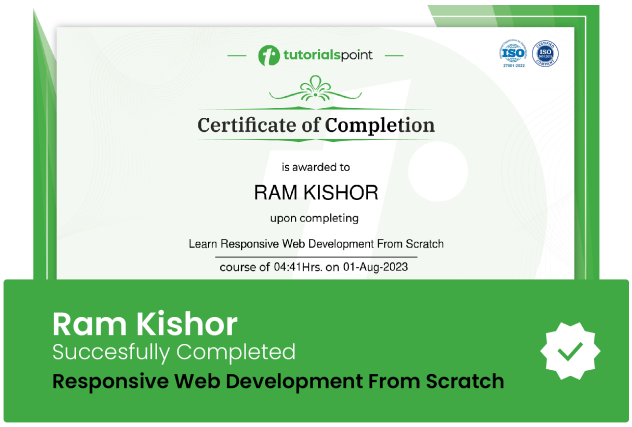
Course Certificate
Use your certificate to make a career change or to advance in your current career.
Our students work
with the Best
















Related Video Courses
View MoreAnnual Membership
Become a valued member of Tutorials Point and enjoy unlimited access to our vast library of top-rated Video Courses
Subscribe now
Online Certifications
Master prominent technologies at full length and become a valued certified professional.
Explore Now