Mastery in Advanced Machine Learning & Applied AI™
Unlocking Next-Level AI Solutions with Cutting-Edge Machine Learning Techniques and Real-World Applications
 Updated on Oct, 2026
 Language - English
AI Assistant

Lectures -47
Duration -20.5 hours
Lifetime Access

Lifetime Access
30-days Money-Back Guarantee
Get your team access to 10000+ top Tutorials Point courses anytime, anywhere.
Course Description
This comprehensive program is designed to transform learners into experts in advanced machine learning and applied AI, covering both supervised and unsupervised learning techniques. The course focuses on the practical application of cutting-edge methods and algorithms, enabling learners to tackle complex real-world problems across various domains.
Course Outline
1. Introduction to Machine Learning
Understanding the basics of machine learning and its types: supervised, unsupervised, and reinforcement learning.
2. Machine Learning - Reinforcement Learning
Dive deep into reinforcement learning, covering key concepts such as agents, environments, and rewards.
3. Introduction to Supervised Learning
Learn the principles of supervised learning, including classification and regression tasks.
4. Machine Learning Model Training and Evaluation
Explore how to train machine learning models and evaluate their performance using metrics like accuracy, precision, recall, and F1 score.
5. Machine Learning Linear Regression
Understand the concept of linear regression and its application in predicting continuous values.
6. Machine Learning - Evaluating Model Fit
Techniques for assessing how well a model fits the data, including error metrics and residual analysis.
7. Application of Machine Learning - Supervised Learning
Hands-on application of supervised learning techniques to real-world problems.
8. Introduction to Multiple Linear Regression
Explore multiple linear regression and its application when dealing with multiple predictor variables.
9. Multiple Linear Regression - Evaluating Model Performance
Learn how to assess the performance of multiple linear regression models using metrics like R² and Adjusted R².
10. Machine Learning Application - Multiple Linear Regression
Practical exercises applying multiple linear regression to complex datasets.
11. Machine Learning Logistic Regression
Study logistic regression for binary classification tasks.
12. Machine Learning Feature Engineering - Logistic Regression
Techniques to optimize feature selection and transformation for better model performance in logistic regression.
13. Machine Learning Application - Logistic Regression
Practical application of logistic regression to classify data based on binary outcomes.
14. Machine Learning Decision Trees
Learn the fundamentals of decision trees and how they can be used for both classification and regression tasks.
15. Machine Learning - Evaluating Decision Trees Performance
Assessing decision trees' performance using criteria such as Gini index and Information Gain.
16. Machine Learning Application - Decision Trees
Apply decision tree algorithms to real-world datasets for classification tasks.
17. Machine Learning Random Forests
Understand ensemble learning through random forests and their advantages over single decision trees.
18. Master Machine Learning Hyperparameter Tuning
Learn how to fine-tune machine learning models for optimal performance using techniques such as grid search and random search.
19. Machine Learning Decision Trees Random Forest
Apply and compare decision trees and random forests to real-world problems.
20. Machine Learning - Support Vector Machines (SVM)
Master the theory and application of SVM for classification tasks, including the role of hyperplanes and support vectors.
21. Machine Learning - Kernel Functions in Support Vector Machines (SVM)
Understand the use of kernel functions to transform non-linear data into a higher-dimensional space for better classification.
22. Machine Learning Application - Support Vector Machines (SVM)
Practical applications of SVMs in classification tasks.
23. Machine Learning K-Nearest Neighbor (KNN) Algorithm
Study the KNN algorithm, a simple yet powerful method for classification and regression tasks.
24. Machine Learning Application - KNN Algorithm
Implement KNN for real-world data analysis.
25. Machine Learning Gradient Boosting Algorithms
Master advanced ensemble methods like gradient boosting, which combine weak models to create a strong model.
26. Master Hyperparameter Tuning in Machine Learning
Learn advanced techniques for optimizing model parameters to improve predictive performance.
27. Machine Learning Application of Gradient Boosting
Hands-on experience applying gradient boosting algorithms to complex datasets.
28. Machine Learning Model Evaluation Metrics
Study the various evaluation metrics for different types of machine learning models, such as precision, recall, F1 score, and confusion matrix.
29. Machine Learning ROC Curve and AUC Explained
Learn how to use the ROC curve and AUC to assess the performance of classification models.
30. Unsupervised Learning Explained | Clustering & Dimensionality Reduction
An introduction to unsupervised learning techniques such as clustering and dimensionality reduction.
31. Unsupervised Learning Explained - Anomaly Detection
Study anomaly detection techniques to identify outliers and abnormal patterns in data.
32. Mastering K-Means Clustering in Unsupervised Learning
Understand the K-Means algorithm and its application in clustering data.
33. Iterating K-Means Clustering Algorithm in Unsupervised Learning
Learn how to refine and optimize K-Means clustering for better results.
34. Application of K-Means Clustering Algorithm in Unsupervised Learning
Hands-on experience applying K-Means clustering to real-world problems.
35. Mastering Hierarchical Clustering in Unsupervised Learning
Understand hierarchical clustering techniques and their applications in unsupervised learning.
36. Unsupervised Learning Dendrogram Visualization
Visualize hierarchical clustering results using dendrograms to better understand data structures.
37. Application Hierarchical Clustering Explained - Master Unsupervised Learning
Apply hierarchical clustering to solve practical unsupervised learning tasks.
38. Advanced Clustering Techniques Unsupervised Learning with DBSCAN
Study DBSCAN, an advanced clustering algorithm that handles noise and non-spherical clusters.
39. Advanced Clustering Techniques - Unsupervised Learning with DBSCAN Advantages
Learn the advantages of DBSCAN over traditional clustering techniques like K-Means.
40. Introduction to Principal Component Analysis (PCA)
Understand PCA, a dimensionality reduction technique that simplifies high-dimensional data.
41. Selecting Principal Component Analysis (PCA)
Learn how to select the most important principal components to reduce data dimensionality effectively.
42. Application of Principal Components in PCA
Hands-on application of PCA to reduce dimensionality and improve model performance.
43. Unsupervised Learning with Linear Discriminant Analysis (LDA)
Learn LDA, a dimensionality reduction technique commonly used in classification tasks.
44. PCA vs LDA | Machine Learning Dimensionality Reduction
Compare PCA and LDA to understand their differences and appropriate use cases.
45. Application of LDA | Machine Learning Dimensionality Reduction
Apply LDA for dimensionality reduction in supervised learning tasks.
46. Unsupervised Learning with t-SNE
Study t-SNE (t-Distributed Stochastic Neighbor Embedding) for nonlinear dimensionality reduction.
47. Unsupervised Learning - How t-SNE Works - Mastering Dimensionality Reduction
Understand how t-SNE works and how it can be applied to visualize high-dimensional data.
48. Application of t-SNE - Mastering Dimensionality Reduction
Apply t-SNE to explore data patterns and visualize complex datasets in lower dimensions.
49. Unsupervised Learning Model Evaluation Metrics - A Complete Guide
Learn about evaluation metrics used to assess the performance of unsupervised learning models.
50. Dimensionality Reduction Evaluation Metrics
Study the metrics used to evaluate the effectiveness of dimensionality reduction techniques.
51. Unsupervised Learning Hyperparameter
Explore hyperparameter tuning in unsupervised learning to optimize model performance.
52. Unsupervised Learning with Bayesian Optimization - A Complete Guide
Learn Bayesian Optimization and its applications in improving the performance of unsupervised learning algorithms.
53. Introduction to Association Rule
Understand association rule mining and its application in market basket analysis.
54. Association Rule Mining - Confidence & Support Explained
Dive into confidence and support metrics used to evaluate association rules.
55. Apriori Algorithm Association Rule Mining & Market Basket Analysis
Study the Apriori algorithm and its application to market basket analysis for uncovering product relationships.
56. Apriori Algorithm Step-by-Step Explained
A detailed explanation of the Apriori algorithm and how to apply it to real-world data.
This course equips students with the tools and knowledge to excel in machine learning, from foundational concepts to advanced applications, making it ideal for those looking to master the field of AI and machine learning.
Goals
- Introduction to the foundational concepts of Machine Learning.
- Understanding Reinforcement Learning and its applications in decision-making.
- Introduction to Supervised Learning and its role in predictive modeling.
- Techniques for training and evaluating Machine Learning models effectively.
- In-depth exploration of Linear Regression and its application in predictive tasks.
- Evaluating the fit of machine learning models for better accuracy.
- Applying Supervised Learning techniques in real-world data scenarios.
- Introduction to Multiple Linear Regression for modeling multiple variables.
- Evaluating the performance of Multiple Linear Regression models.
- Practical applications of Multiple Linear Regression in solving business problems.
- Mastery of Logistic Regression and its use in classification tasks.
- Feature engineering techniques to improve Logistic Regression models.
- Application of Logistic Regression for classification and prediction.
- Understanding Decision Trees and their use in machine learning.
- Evaluating the performance of Decision Trees for optimal predictions.
- Applying Decision Trees to real-world problems in various industries.
- Mastering Random Forests and their advantages for predictive tasks.
- Techniques for Hyperparameter Tuning to optimize machine learning models.
- Combining Decision Trees and Random Forests for enhanced predictive power.
- Mastering Support Vector Machines (SVM) for classification tasks.
- Understanding Kernel Functions in SVM to handle non-linear data.
- Real-world applications of Support Vector Machines for classification problems.
- Implementing K-Nearest Neighbor (KNN) algorithm for supervised learning.
- Practical applications of KNN algorithm for classification and prediction.
- Understanding Gradient Boosting algorithms and their power in predictive tasks.
- Mastering Hyperparameter Tuning to improve Gradient Boosting models.
- Application of Gradient Boosting in various machine learning problems.
- Mastering evaluation metrics to assess the performance of machine learning models.
- Understanding and using ROC Curve and AUC for model performance assessment.
- Introduction to Unsupervised Learning concepts, focusing on clustering and dimensionality reduction.
- Mastering Anomaly Detection techniques for identifying outliers in data.
- Advanced techniques in K-Means Clustering for unsupervised learning tasks.
- Iterating the K-Means algorithm to improve clustering results.
- Practical applications of K-Means Clustering in real-world scenarios.
- Mastering Hierarchical Clustering techniques for data segmentation.
- Visualizing Hierarchical Clustering using Dendrograms for clear insights.
- Advanced clustering techniques using DBSCAN and understanding its advantages.
- Introduction to Principal Component Analysis (PCA) for dimensionality reduction.
- Selecting optimal components in PCA for efficient data reduction.
- Applying PCA in real-world problems to reduce data dimensions.
- Understanding Linear Discriminant Analysis (LDA) and its role in unsupervised learning.
- Comparing PCA vs LDA for dimensionality reduction techniques.
- Applying LDA for dimensionality reduction and classification in machine learning.
- Mastering t-SNE for advanced dimensionality reduction and visualization.
- Understanding how t-SNE works and using it to visualize high-dimensional data.
- Applying t-SNE for reducing dimensions and visualizing complex datasets.
- Evaluating unsupervised learning models with specific evaluation metrics.
- Understanding and applying dimensionality reduction evaluation metrics.
- Hyperparameter tuning techniques for optimizing unsupervised learning models.
- Using Bayesian Optimization for improving the performance of unsupervised models.
- Introduction to Association Rule Mining for extracting patterns from data.
- Understanding Confidence and Support in Association Rule Mining for actionable insights.
- Using the Apriori Algorithm in Association Rule Mining for Market Basket Analysis.
- Step-by-step explanation and application of the Apriori Algorithm in real-world analysis.
Prerequisites
Anyone can learn this class with simplicity end to end
Anyone who wants to learn future skills and become Data Scientist, Sr. Data Scientist, Ai Scientist, Ai Engineer, Ai Researcher & Ai Expert.
Curriculum
Check out the detailed breakdown of what’s inside the course
Introduction
1 Lectures
-
 Introduction
37:49
37:49
Introduction
37:49
37:49
Machine Learning- Reinforcement Learning
1 Lectures

Introduction to Supervised Learning
1 Lectures
Machine Learning Model Training and Evaluation
1 Lectures
Machine Learning Linear Regression
1 Lectures
Machine Learning Linear Regression
1 Lectures
Machine Learning- Evaluating Model Fit
1 Lectures
Application of Machine Learning- Supervised Learning
1 Lectures
Introduction to Multiple Linear Regression
1 Lectures
Multiple Linear Regression- Evaluating Model Performance
1 Lectures
Machine Learning Application- Multiple Linear Regression
1 Lectures
Machine Learning Logistic Regression
1 Lectures
Master Hyperparameter Tuning in Machine Learning
1 Lectures
Machine Learning Application- Logistic Regression
1 Lectures
Machine Learning Decision Trees
1 Lectures
Machine Learning- Evaluating Decision Trees Performance
1 Lectures
Machine Learning Application- Decision Trees
1 Lectures
Machine Learning Random Forests
1 Lectures
Master Machine Learning Hyperparameter Tuning
1 Lectures
Machine Learning Decision Trees Random Forest
1 Lectures
Master Machine Learning- Support Vector Machines (SVM)
1 Lectures
Machine Learning Application- Support Vector Machines (SVM)
1 Lectures
Machine Learning Preprocessing for KNN Algorithm
1 Lectures
Machine Learning Application KNN Algorithm
1 Lectures
Machine Learning Gradient Boosting Algorithm
1 Lectures
Master Hyperparameter Tuning in Machine Learning
1 Lectures
Machine Learning Application of Gradient Boosting
1 Lectures
Machine Learning Model Evaluation Metrics
1 Lectures
Machine Learning ROC Curve and AUC Explained
1 Lectures
Unsupervised Learning Explained | Clustering & Dimensionality Reduction
1 Lectures
Unsupervised Learning Explained- Anomaly Detection
1 Lectures
Mastering K-Means Clustering in Unsupervised Learning
1 Lectures
Iterating K-Means Clustering Algorithm in Unsupervised Learning
1 Lectures
Application of K-Means Clustering Algorithm in Unsupervised Learning
1 Lectures
Unsupervised Learning Dendrogram Visualization
1 Lectures
Application Hierarchical Clustering Explained- Master Unsupervised Learning
1 Lectures
Advanced Clustering Techniques Unsupervised Learning with DBSCAN
1 Lectures
Advanced Clustering Techniques- Unsupervised Learning with DBSCAN Advantages
1 Lectures
Application Advanced Unsupervised Learning with DBSCAN Algorithm
1 Lectures
Introduction to Principal Component Analysis (PCA) | Machine Learning & Data Reduction
1 Lectures
Selecting Principal Component Analysis (PCA) | Machine Learning
1 Lectures
Unsupervised Learning with Linear Discriminant Analysis (LDA)
1 Lectures
PCA vs LDA | Machine Learning Dimensionality Reduction Explained
1 Lectures
Application of LDA | Machine Learning Dimensionality Reduction Explained
1 Lectures
Unsupervised Learning with t-SNE- Mastering Dimensionality Reduction
1 Lectures
Unsupervised Learning- How t-SNE Works - Mastering Dimensionality Reduction
1 Lectures
Application of t-SNE- Mastering Dimensionality Reduction
1 Lectures
Instructor Details

Dr. Noble Arya
Warm greetings and a heartfelt welcome!
I am Dr. Noble Arya, a Full-Stack Data Scientist, AI/ML/DL Researcher, Product Innovator, and lifelong learner. My professional journey has given me the opportunity to work with leading global organisations, including General Electric (GE) and Wipro Technologies, where I gained valuable experience in technology, innovation, and solving real-world challenges.
As the founder of NobleX Infinity Labs™, I have had the privilege of mentoring and inspiring more than 100,000 learners and 500 educators across 170 countries. Our educational programs have received an average rating of 4.9 out of 5 stars, reflecting the trust, encouragement, and feedback of over 100,000 learners.
My academic journey reflects my belief that learning should never stop. He has been awarded a Doctorate in Artificial Intelligence and Machine Learning, has pursued postgraduate medical education in Telemedicine through Harvard Medical School, and completed the Post Graduate Program in Artificial Intelligence and Machine Learning, offered through The University of Texas at Austin and Great Learning.
With more than 17+ years of experience in Artificial Intelligence, Machine Learning, Data Science, Deep Learning, and Value Innovation, I have come to believe that the true purpose of technology is not simply to make machines more intelligent, but to help human beings become more conscious, creative, compassionate, and capable.
Throughout my journey, I have been fortunate to receive more than 300+ national and international awards and recognitions for contributions to future skills, creativity, technological innovation, and ethical AI. While these recognitions are meaningful, what matters most to me is the opportunity to make a positive difference in someone's life through education.
My interests extend beyond technology. I am deeply passionate about Computer Science, Artificial Intelligence, Design Thinking, Pure Consciousness, Human Potential, and Value Innovation. I believe that meaningful progress happens when scientific understanding, human creativity, and deeper awareness come together.
Over the years, my learning and professional journey have brought me into contact with institutions and organisations such as Teach For India, Harvard Medical School, the University of Texas at Austin, and Toastmasters International. Each experience has contributed to my understanding of education, leadership, innovation, and the importance of human values.
As an entrepreneur, I have also experienced the challenges and rewards of building two startups from modest beginnings into nationally and internationally recognised ventures. These experiences taught me that innovation is not only about having great ideas. It is about persistence, experimentation, learning from failure, and creating genuine value for people.
My work and interests span several interconnected fields:
Artificial Intelligence, Machine Learning, and Deep Learning
Data Science, Computer Science, and Real-World Problem-Solving
Design Thinking, Product Development, and Value Innovation
Digital Transformation and Future Skills
Project Management, Entrepreneurship, and Leadership
Pure Consciousness, Human Awareness, and Value-Based Technology
Having worked on more than 100 projects over the past 15 years, I have learned one important lesson: knowledge becomes truly valuable when we use it to solve real problems and improve lives.
This belief continues to shape my mission.
Through my Udemy courses, YouTube channel, research initiatives, and educational programs, I want to make high-quality learning more accessible, practical, affordable, and meaningful for people from all walks of life.
My vision is ambitious, but it comes from a simple conviction: every human being deserves the opportunity to learn, grow, innovate, and realise their potential.
Over the coming decade, I aspire to contribute to the empowerment of 7 billion people worldwide, through both online and offline education, by helping them develop real-world problem-solving skills, technological understanding, creativity, and ethical awareness.
I envision a future in which Artificial Intelligence does more than automate tasks or improve productivity. I hope it becomes a powerful instrument for expanding human capabilities, nurturing consciousness, encouraging compassion, and creating a more inclusive and sustainable world.
Technology should serve humanity, and humanity should grow in wisdom alongside technology.
To me, education is not simply about acquiring certificates, mastering algorithms, or advancing careers. It is about discovering our potential, questioning our assumptions, understanding the world more deeply, and using our knowledge responsibly.
Whether you are a student, educator, researcher, entrepreneur, working professional, or simply someone curious about the future, I warmly invite you to be part of this lifelong learning journey.
Connect with me through Udemy and YouTube. Let us explore ideas, challenge conventional thinking, develop practical skills, and build a future where intelligence, innovation, consciousness, and compassion work together for the benefit of humanity.
I remain deeply grateful to the Creator, to every teacher and learner who has shaped my journey, and to the extraordinary universe of which we are all a part.
From the smallest atom to the infinite universe, may our pursuit of knowledge always be guided by wisdom, humility, gratitude, and love.
Thank you for being part of this journey.
With heartfelt gratitude and sincere regards,
Dr. Noble Arya
Founder, NobleX Infinity Labs™
Full-Stack Data Scientist | AI/ML/DL Researcher | Product Innovator
Educator | Entrepreneur | Lifelong Learner
Learning Beyond Boundaries. Innovating with Consciousness. Empowering Humanity.
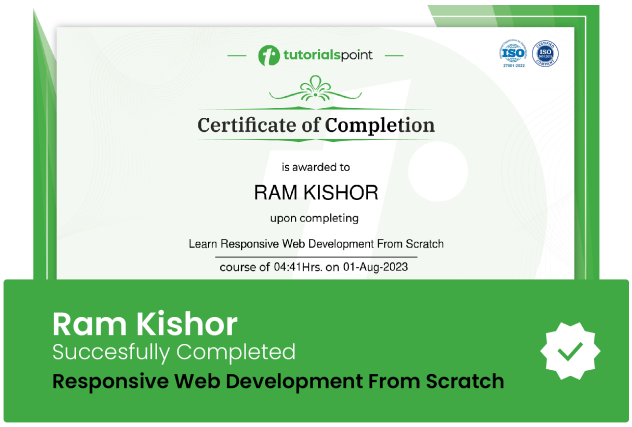
Course Certificate
Use your certificate to make a career change or to advance in your current career.
Our students work
with the Best

















Related Video Courses
View MoreAnnual Membership
Become a valued member of Tutorials Point and enjoy unlimited access to our vast library of top-rated Video Courses
Subscribe now
Online Certifications
Master prominent technologies at full length and become a valued certified professional.
Explore Now