Optical CPU Design
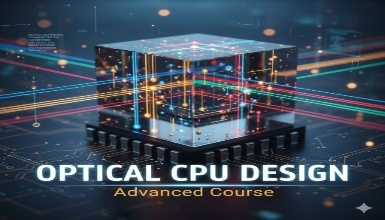
The goal of this course is to introduce the student to digital photonics
 Updated on Aug, 2026
 Language - English
 IT and Software ,Operating Systems and Servers,
Lectures -11
Resources -11
Duration -46 mins
Lifetime Access

Lifetime Access
30-days Money-Back Guarantee
Get your team access to 10000+ top Tutorials Point courses anytime, anywhere.
Course Description
This course introduces the student to Digital Photonics. I have kept everything simple and to the point with a description of just a 4-bit optical CPU. Thus, the registers with parallel load don’t use specialized circuitry for parallel load; I just clock the clock line when needed in order to load values into a D-type Register. This is naïve, but the circuit works with slight nuances.
The goal of this course is to show the student a basic optical CPU to show it works and to describe in detail the workings, including a scalable and possibly reusable micro-programmable optical control unit.
The optical control unit uses a basic setup, which is a mapping ROM attached to a presettable binary counter attached to a control ROM, of which the outputs are programmed and map to various circuits for clocking or for setting a multiplexer or demultiplexer, etc. The component count, including optical waveguides and pivot points, is around 1000 components.
This course was a journey for me into optical circuit design with my own self-designed Digital Photonic simulation software. I am sharing my first journey with the software, which is a basic 4-bit optical CPU. The hobby software took about 6 long years to design, and this circuit was used to test the software. I hope the course satisfies your curiosity of digital Photonics.
You should note that with this simulator, I use proof of concept algorithms where a high intensity maps to a logic 1 and a low intensity maps to a logic 0. Thus, at a high level, the hardware algorithm can be shown to work. This is similar to Digital Electronics, but in the optical domain.
Goals
- The goal of this course is to introduce the student to digital photonics.
Prerequisites
- For this course all a student needs is to have a basic understanding of digital logic.
Curriculum
Check out the detailed breakdown of what’s inside the course
Introduction
1 Lectures
-
 Introduction
00:49
00:49
Introduction
00:49
00:49
Overview
1 Lectures

Registers
1 Lectures
Multiplexers
1 Lectures
De-Multiplexers
1 Lectures
Binary Counter
1 Lectures
Presettable Binary Counter
1 Lectures
The Arithmetic Logic Unit (ALU)
1 Lectures
The optical CPU with manual control
1 Lectures
The control unit
1 Lectures
The Optical CPU with the control unit and program counter (PC)
1 Lectures
Instructor Details
Michael Cloran
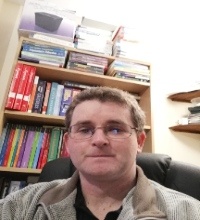
Michael Cloran is an experienced instructor who brings clarity, practical insight, and a learner-first approach to his teaching. With a strong foundation in his field, he focuses on breaking down complex concepts into simple, easy-to-understand lessons. Michael is passionate about helping learners build real-world skills and confidence, making his sessions engaging, informative, and highly practical for students at all levels.
Course Certificate
Use your certificate to make a career change or to advance in your current career.
Our students work
with the Best













Related Video Courses
View MoreAnnual Membership
Become a valued member of Tutorials Point and enjoy unlimited access to our vast library of top-rated Video Courses
Subscribe now
Online Certifications
Master prominent technologies at full length and become a valued certified professional.
Explore Now