Sovereign AI Infrastructure: 100 Labs to Principal Architect
Stop micro-managing code and start orchestrating intelligence. Learn to build resilient AI clusters.
 Updated on Oct, 2026
 Language - English
AI Assistant

Lectures -112
Resources -100
Duration -1.5 hours
Lifetime Access

Lifetime Access
30-days Money-Back Guarantee
Get your team access to 10000+ top Tutorials Point courses anytime, anywhere.
Course Description
- Architect Sovereign AI Clusters: Design private, high-density compute environments that meet local control and "Digital Sovereignty" requirements.
- Orchestrate GPU Fleets: Master Volcano and Kueue for "gang-scheduling" multi-thousand GPU training jobs without wasting a single cycle.
- Standardize Context Delivery: Implement Model Context Protocol (MCP) servers to connect LLMs to production backends seamlessly.
- Deploy via "Vibe Coding": Transition from syntax-heavy manual work to Intent-Driven Development, using AI agents to deploy production-grade endpoints.
- Audit for Global Resilience: Map infrastructure to EU AI Act and DORA standards to ensure your systems are "Resilient by Design."
- The Kubelet (The Room Attendant): Ensures every room (Pod) is clean, functional, and occupied by the right guest (Container).
- The Kube-Scheduler (The Booking Agent): A clerk who assigns guests to rooms based on their specific needs for "luxury" resources like memory or GPUs.
- The Etcd (The Front Desk Ledger): The single source of truth for every booking and guest detail in the building.
- Autoscaling (The Flexible Wing): Just as a hotel opens a new wing during a holiday surge, Kubernetes scales your "rooms" instantly as traffic spikes.
- The Conductor (K8s Master): Ensures every section—from the violinists (Nodes) to the instruments (GPUs)—plays in perfect sync.
- Gang Scheduling: The rule that the symphony cannot start until every musician is in their seat. If a few "flutists" are late, the performance is held to prevent a chaotic, incomplete sound.
Who this course is for:
- Currently working in DevOps or SRE roles; recognizes the shift toward GPU-centric infrastructure and hardware-software convergence.
- Experienced Technical Lead or Architect tasked with building private, secure, and self-hosted AI solutions for regulated industries.
- Backend or Full-Stack developer seeking to move beyond high-level API wrappers toward true systems-level AI engineering.
Goals
- Architect production-grade GPU fabrics using NVIDIA Blackwell and AMD ROCm architectures
- Deploy and manage large-scale Kubernetes clusters specifically tuned for AI workloads
- Master the Model Context Protocol (MCP) to standardize tool calling and context delivery across multiple LLM providers
- Secure AI workloads using hardware-rooted protocols, including Confidential Containers (CoCo), vTPM integration, and encrypted memory enclaves
- Engineer distributed training pipelines using Ray and PyTorch FSDP, optimizing for InfiniBand and RoCEv2 interconnects to achieve near-linear scaling
- Automate regulatory compliance reporting for the EU AI Act and DORA using infrastructure-as-code (IaC) and real-time observability dashboards
- Design high-availability vector database topologies for Retrieval-Augmented Generation (RAG) using Milvus and Kafka for real-time data ingestion at scale
- Construct autonomous multi-agent swarms with stateful persistence using Redis and sandboxed execution environments for secure tool use
Prerequisites
- The curriculum is structured to be accessible to experienced software practitioners while maintaining the technical depth required for high-level infrastructure roles. Software Proficiency: Proficiency in Python 3.12+ and a working knowledge of the Linux Command Line Interface (CLI) are essential. Infrastructure Context: A foundational understanding of containerization (Docker) and basic Kubernetes concepts (Pods, Services, Namespaces) is recommended. Hardware Accessibility: A local machine with at least 16GB of RAM is necessary for the initial local sandbox modules. Later modules involving GPU acceleration can be completed using cloud-based GPU instances or local NVIDIA hardware (RTX 30-series or higher recommended). Engineering Mindset: A commitment to the "Engineering over Vibe Coding" philosophy—the willingness to debug networking layers, compile drivers, and analyze low-level system logs.

Curriculum
Check out the detailed breakdown of what’s inside the course
Introduction
1 Lectures
-
 Introduction
06:15
06:15
Introduction
06:15
06:15
Module 1: Foundations & The Local AI Sandbox
11 Lectures

Module 2: Enterprise Containerization & GitOps
11 Lectures
Module 3: Accelerated Compute Fundamentals (GPUs & TPUs)
11 Lectures
Module 4: Distributed Training Networks
11 Lectures
Module 5: Serving Infrastructure & Inference Scaling
11 Lectures
Module 6: Hardware-Rooted Security & Zero Trust AI
11 Lectures
Module 7: Sovereign Data Pipelines & Vector Architectures
11 Lectures
Module 8: Agentic Orchestration & the Model Context Protocol
11 Lectures
Module 9: Enterprise Observability, Resilience & FinOps
11 Lectures
Module 10: Sovereign Deployment & Decentralized Research
11 Lectures
Coclusion
1 Lectures
Instructor Details

Bayt Al Hikmah
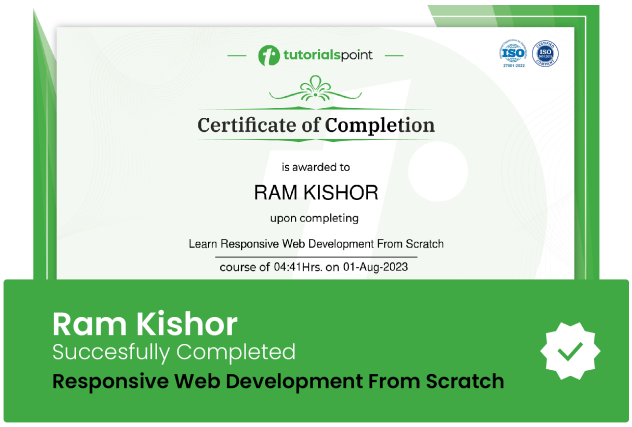
Course Certificate
Use your certificate to make a career change or to advance in your current career.
Our students work
with the Best















Related Video Courses
View MoreAnnual Membership
Become a valued member of Tutorials Point and enjoy unlimited access to our vast library of top-rated Video Courses
Subscribe now
Online Certifications
Master prominent technologies at full length and become a valued certified professional.
Explore Now